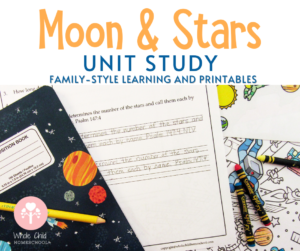
Moon & Stars Unit Study for Upper Elementary
A Family-Style Moon & Stars Unit Study for Homeschoolers to use at Morning Time and for Family Schooling
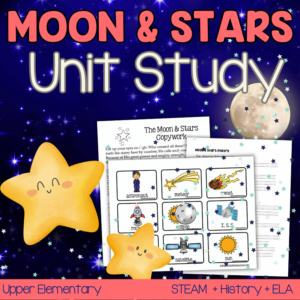
This moon & stars unit study is for upper elementary students learning about our closest neighbor in space, the moon, as well as stars and astronomy.
In this moon and stars unit study, your students will make moon craters; study and learn the major constellations; discover (and taste!) the phases of the moon; what gravity has to do with Jackson Pollock’s art; count how many zeros are in 100 billion; find out why Galileo is famous and what he discovered; and much more.
There are four individual units within this Astronomy and Astronauts unit study:
Moon and Stars: Early Learners, Upper Elementary, Middle & High School
Space and Planets: Early Learners, Upper Elementary, Middle & High School
Rockets and Spacecraft: Early Learners, Upper Elementary, Middle & High School
Astronauts: Early Learners, Upper Elementary, Middle & High School
Each theme has three posts with activities for Early Learners (preschool to 2nd grade), Upper Elementary (3rd to 5th grade), and Middle to High School (6th grade and up).
Some links in this post may be affiliate links. This means that if you click on them, I may make a tiny commission, at no extra cost to you.
Moon & Stars Language Arts Lessons
Read Aloud and Living Books
Along Came Galileo by Jeanne Bendick is an easy to read book for intermediate and middle school students. This book is a great choice for your home library. It has an extensive history of Galileo and his research in astronomy, philosophy, engineering, and physics. You’ll find this book more easily if you look at the publisher’s site, Beautiful Feet Books, or a homeschool catalog, such as Rainbow Resource.
Starry Messenger: Galileo Galilei (Caldecott Honor Book) by Peter Sis is a picture book with text written for upper elementary about the life and works of Galileo, a scientist who was stood up for his convictions even though it cost him his freedom.
The Moon Book by Gail Gibbons is a comprehensive look at the Earth’s moon. This book works well as an independent reader for 3rd to 5th grade. The Moon Book is filled with facts, vocabulary, and even a few folktales about the moon.
Grammar and Copywork
For families that use narration to work on grammar, there is a narration page in our free resource library. This narration page uses quotes from Gail Gibbon’s The Moon Book. There are different quotes for each of the three levels (early learners, upper elementary, and middle to high school) that target different grammatical concepts.
Vocabulary

I’ve created a list of vocabulary to go with the astronomy and astronauts unit. You can use these picture cards as a word wall or as flashcards. Or you could use them as writing prompts and spelling words.
Moon and Stars Copy Work and Handwriting

Use the 5 Moon & Stars copywork printables (in the Free Resource Library) to practice handwriting while also learning Bible verses that coordinate with this unit study.
Reading Comprehension
Want to check your student’s reading comprehension or pick out some facts for memorization? Then use this upper elementary-level Reading Comprehension worksheet from the Free Resource Library after your students read The Moon Book by Gail Gibbons or a similar title with facts about the moon.

Moon and Stars STEAM
Nature Study of Constellations
Glow in the Dark Constellations: A Field Guide for Young Stargazers by C.E. Thompson is a wonderful, easy-to-use guide for beginning astronomers. This book is written for constellations easily seen from the continental United States. It includes details about 33 constellations plus step-by-step directions for viewing each. Most constellations are named after Greek and Roman gods. Therefore, it includes a bit of the accompanying myth for each of the Greek and Roman gods.
You’ve probably never heard of her, but Henrietta Leavitt discovered what an individual star’s brightness means. Read the book, Look Up!: Henrietta Leavitt, Pioneering Woman Astronomer, by Robert Burleigh to learn more about this woman astronomer.
Science
Eyewitness Explorer Night Sky Detective has great hands-on activities. To begin this week, explore gravity and make moon craters as described on page 21. Second, check out the phases of the moon while you chart the moon (page 22). Finally, learn why the moon doesn’t totally disappear during a lunar eclipse using the activity on page 25.
Build your own telescope with the instructions from National Geographic Kids that use paper towel tubes and lenses from old reading glasses (or buy a pair of “cheaters” from the dollar store).
Next, make a constellation projector with a flashlight or smartphone and these printables from PlaygroundParkbench.com.
Learn about the physics of gravity with Looney Tunes and Wile E. Coyote and the Roadrunner in Whoosh!: Wile E. Coyote Experiments with Flight and Gravity
Learn why gravity is important in the book You Wouldn’t Want to Live Without Gravity by Anne Rooney
Complete the Night Explorer’s program from the National Park Service’s Jr. Rangers and earn a badge.

Next, a moon and stars unit study wouldn’t be complete with Oreo cookies!
First, read about the moon phases in The Smithsonian Eyewitness Explorer Night Sky Detective. And watch this phases of the moon video from Free School.
Second, Use the Oreo moon phases matching worksheet from the Moon and Stars Unit Study Bundle. Then grab some Oreos to replicate the phases of the moon.
Finally, don’t forget to take a picture of your project before you eat it!
Alternatively, if your family prefers not to “play” with food items, have your kids create this phases of the moon wreath instead.
Your students with stronger writing skills can use these phases of the moon notebooking pages from our sister site, Homeschool Helper Online to describe the process that our moon goes through each month.
Math
No one knows how many stars are in the universe. Some scientists estimate that there may be 100 billion trillions. Have your students write out that number and see how many zeros it takes. How many stars does your student think there are in the universe? Have them write out that number, too.
Next, if your students enjoyed the story Archimedes and the Golden Crown audiobook, have them learn about Archimedes’ Osteomachion Math Puzzle. This puzzle is the oldest math puzzle and is similar to a tanagram. The osteomachion is sometimes called Stomachion Math Puzzle. You’ll find several versions on Pinterest or use these instructions from TeachBesideMe.com


-
 Product on saleAstronomy to Astronauts Outer Space Bundle: All 4 Unit Studies in OneOriginal price was: $56.00.$40.00Current price is: $40.00.

Moon and Stars History and Extras
Astronomy History
Along Came Galileo by Jeanne Bendick is an easy to read (and inexpensive) book for upper elementary students. It’s another title that you will want for your home library. This book contains an extensive history of Galileo and his research in astronomy, philosophy, engineering, and physics. Published by Beautiful Feet Books, I recommend buying it directly from the publisher or a homeschool catalog, such as Rainbow Resource.

Use this Galileo notebooking page from HomeschoolHelperOnline.com to record what you learned about Galileo’s life after reading Along Came Galileo.
Galileo and the Stargazers as written and told by Jim Weiss audiobook also includes the story Archimedes and the Golden Crown. Who doesn’t love Jim Weiss’ storytelling? Both of these stories contain an abundance of facts along with humorous notes. This audiobook can usually be found at your local library.
The Animated Hero Classics: Galileo DVD by Nest Entertainment nicely illustrates how new science ideas were not readily accepted during Galileo’s lifetime. As a result of this, Galileo had to choose between punishment and standing up for what he believed to be true. This DVD can be found at many libraries and is often included in Amazon Prime.
Devotions
Our family loves the devotional book Indescribable: 100 Devotions
The following devotions match up nicely with this moon and stars unit study:
- 26-27
- 58-59
- 68-69
- 90-91
- 130-131
- and 134-135.
Fine Arts
Jackson Pollock used gravity to create his drip paintings. Pollock described his most famous work, Number One (Lavender Mist), as “energy and motion made visible”. Explore how gravity plays a part in this painting style by dropping paint from a brush onto a large sheet of paper while standing on a stepladder.
More Ideas
Family schooling naturally has an overlap between learner’s abilities. That’s why morning baskets and unit studies work so well for homeschool families with more than one kiddo! Therefore, there may be activities
Moon and Stars: Early Learners, Upper Elementary, Middle to High School
Next, make sure to follow my Pinterest board Astronomy and Astronauts to get more ideas for your Moon & Stars unit study.
Pin this to your favorite board so you can find it again! And be sure to follow Whole Child Homeschool on Pinterest for 1000s of Free Homeschooling Resources and Ideas!