Astronauts Unit Study for Preschool & Early Elementary Homeschoolers
An Astronauts Family School Unit Study for Morning Baskets and Family-Style Homeschooling with Students in Preschool to 2nd grade!

In this Astronauts Unit Study, your students will
- Create their own control panels
- Name their spaceship using alliteration
- Learn about the women of NASA (Hidden Figures)
- Find out what astronauts do at their jobs
- And find out why Frisbees were first marketed as “UFOs”
- Plus many other fun lessons & activities!
These activities are a part of a series of posts about Astronomy and Astronauts. The Astronauts Unit Study is part 4 of 4.
This astronaut unit study is for a family-style morning basket time or unit study. Each of the four sections has activities for Early Learners (preschool to 2nd grade), Upper Elementary (3rd to 5th grade), and Middle & High School (6th grade and up). There are four sections for this Astronomy and Astronauts unit study:
Moon and Stars: Early Learners, Upper Elementary, Middle & High School
Space and Planets: Early Learners, Upper Elementary, Middle & High School
Rockets and Spacecraft: Early Learners, Upper Elementary, Middle & High School
Astronauts: Early Learners, Upper Elementary, Middle & High School
Some links in this post may be affiliate links. This means that if you click on them, I may make a tiny commission, at no extra cost to you.
Astronauts English Language Arts
Living Picture Books
Mousetronaut by Astronaut Mark Kelly is a “mostly true” story of a mouse named Meteor. Meteor is selected to be an astronaut alongside some humans and takes a journey on the space shuttle Endeavor’s 2001 mission. This story emphasizes the value of hard work, courage, and having a purpose. And you can watch the author’s twin brother, astronaut Scott Kelly, read Mousetronaut from the ISS in StoryTime From Space! There’s also a nice afterword and bibliography with internet resources for older kids to extend their learning at the end of the book.
One Giant Leap by Robert Burleigh vividly describes the unity and hope of the American people as they watched Apollo 11 land on the moon. This picture book is one that your older kids will enjoy as well. There is another picture book by the same title, written by Don Brown, that is a biography of Neil Armstrong. It’s worth checking out also if your local library carries it.
Daring Dozen: The Twelve Who Walked on the Moon by Suzanne Slade is told from the perspective of the moon (using personification), which welcomes its visitors. This book honors the twelve men in Apollo Missions 11 to 17 who have walked on the moon. It also briefly explains why Apollo 13 didn’t land on the moon. There are also nice photos of all the astronauts along with a timeline of the missions in the afterword that your older students will enjoy.
I am Neil Armstrong by Brad Meltzer is part of the “Ordinary People Change the World” series. This biography focuses on Neil’s childhood influences and character traits that lead him to become an astronaut. It includes a graphic timeline of his life as well.

Beginning Readers
Lego Women of NASA: Space Heroes by Hannah Dolan describes the life works of four women who have greatly contributed to NASA’s space program. Margaret Hamilton wrote the computer code for the Apollo missions. Sally Ride was the first American woman in space; she was a physicist and an engineer. Nancy Grace Roman is also known as the Mother of Hubble for her work with the Hubble Telescope. Last, but not least, Mae Jemison was the first black woman astronaut. This book is a DK Reader Level 1 In honor of these four pioneers in the space program, Lego has created a set with mini-figures of each woman that comes with the Hubble telescope, a computer, and a space shuttle as part of their Lego Ideas line.
Astronaut: Living in Space by Kate Hayden describes what an astronaut’s life in space is like on a daily basis. This book is a DK Reader Level 2.
Spacebusters: The Race to the Moon by Phillip Wilkinson uses NASA’s photographs as a framework for the history of the space program from Apollo to the space shuttles. This book is a DK Reader Level 3.
Space Heroes: Amazing Astronauts by Buckley and Jenner describes the missions of Yuri Gagarin (the first man in space) and Alan Shepard (the first American in space) as well as a general overview of the Apollo and space shuttle astronauts. This book is a DK Reader Level 3.
Copywork & Grammar


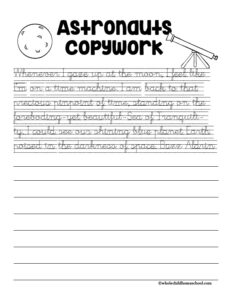
Use the Astronauts Copywork Worksheets in the Free Resource Library to practice grammar and handwriting. There are 3 pages in 3 different levels for early elementary, upper elementary, and middle/high school. Each copywork page features a quote from an astronaut.
Read A Trip into Space by Lori Haskins Houran and talk about all of the words that end with -ing. Ask your kids if they know what part of speech -ing words are. Have them act out each of the -ing words in the book for some bonus gross motor skill practice!

Phonemic Awareness:
Use alliteration to name your spacecraft. Alliteration is an element that an author uses to focus the reader’s attention by using the same beginning letter in a series of words, such as the fire-fighting ferret, or the jackrabbit joyfully jumped. Use the Alliterative Spaceship worksheet from the Free Resource Library and let your child alliteration to name her or his spacecraft.
If your child is stumped, start with the name of an existing spacecraft, like the Endeavor or Columbia. An example using NASA’s latest spacecraft would be “Oliver’s Optimistic Orion”.
To learn more about the importance of phonemic awareness for reading readiness, read this article.
Poetry
Eight Days Gone by Linda McReynolds is a sweet picture book written in a short-verse style of poetry. Retro style illustrations help set the mood for this book about the Apollo 11 lunar landing.
Writing
Use the emergent reader Astronaut Log Book (in the Free Resource Library) to check all of the things your student “did” to become an astronaut and to draw a picture of themselves in their astronaut helmet.


Astronauts STEAM
Science
Join Jesse and Squeaks to learn how to become an astronaut as well as what astronauts do in their jobs in this episode of SciShow Kids.
Learn about the first moonwalk during Apollo 11’s mission in this episode of Things You Want to Know from Nat Geo Kids.
Try a free astronaut simulation app. Apple has Astronaut Training and Android has one called Space for Kids. Playmobil Mars Walk is a good game for younger kids also. NASA has an International Space Station game that is fun also. Or just search the app store for “astronaut simulator”.
Engineering
Let your kids loose with the recycle bin to create a control panel for their spacecraft.
If you started a rocket ship in the Rockets & Spacecraft unit study, just continue to work on it and create a control panel for the inside.
If you don’t have access to a large appliance box from a home improvement or appliance store, you can buy a pop-up rocket ship.
Collect old CDs, maybe a junk computer motherboard or old keyboard to use. Toys like Magnadoodles, toddler busy boxes, and Duplos work really well too. We like to use 3M Command picture hanging strips (often available at the dollar store) for items that we don’t want to ruin with glue or duct tape.
Technology
Space travel and exploration naturally leads to new inventions in order to solve the unique dilemmas of space. Watch this short video from NASA to learn what is an engineer and what an engineer does.
See how astronauts sleep on the International Space Station at The Kids Should See This.
Art
Create a picture of what you see out the window of your spacecraft. Astronauts report that the stars aren’t brighter from the moon or ISS, but they can see thousands more stars than they can on Earth. Try using oil pastels or colored sidewalk chalk on a dark sheet of paper. Use the SpaceX window printable in the Astronaut Unit Study Bundle as a layer over your artwork to make it look like it’s from inside a spacecraft.
Your kids may also enjoy making this moveable Astronaut Puppet Craft from my friends at Red Ted Art.
Math
Most astronauts spend 6 months to a year on the International Space Station. Figure out how many days are in six months.
Learn how to create a bar graph by asking your friends and family if they would want to be an astronaut. Record their responses to create the graph using the Would You Want to be an Astronaut? Bar Graph worksheet in the Free Resource Library.
Astronauts History
Mae Among the Stars by Roda Ahmed tells of a young Mae Jemison who dreams of dancing in space. She grows up to become the first black woman astronaut and travels on the space shuttle Endeavor. She is an amazing role model as she is both a chemical engineer and a medical doctor, in addition to being an astronaut.
Astronauts Sensory
Try some new food textures and explore the technology of
Astronauts Gross and Fine Motor
Fine Motor: Practice writing like an astronaut. Tape a piece of paper to the underneath side of a table. Lay underneath the table and draw on the paper. Try using different writing utensils like felt tip pens, ballpoint pens, crayons, and pencils. Which ones work best? There’s no gravity in space, so writing upside down on Earth is similar to writing in space because the ink doesn’t flow through a ballpoint pen without gravity.
Gross Motor: Frisbees were first marketed as Flying Saucers in response to the Roswell sightings and subsequent UFO hysteria. Later, they were re-named “Pluto Platters” before finally landing on their new name “Frisbee” when the Wham-O company bought the rights. Play frisbee in the yard with a family member or organize a game of Ultimate Frisbee with some homeschool friends.
Astronauts Basic Concepts
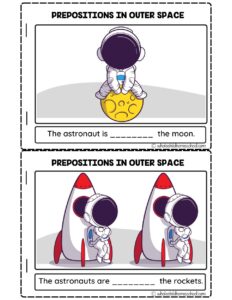
Use the Astronauts basic concepts cards for your youngest, and the Astronauts Prepositional Mini Book for kids in elementary, from the Free Resource Library to teach position words like “next to” or “in front of”.
Use small toys you have around the house or items from the sensory bin for hands-on practice of location words, especially for any location words or phrases your child seems to have trouble with.
For example, you will first to place the toys and tell your child the position word. Next, give your child a few toys and ask them to place the toys next to (or whatever position word they are struggling with) each other. After they have mastered that task, then you can place the toys and ask them to tell you where the toys are. It’s really important to do it in this order because they need to first understand what the word means, then they can use their understanding to use the word properly.
Astronauts Devotions
Our family loves the devotional book Indescribable: 100 Devotions About God and Science by Louie Giglio! These five-minute devotions are filled with wondrous facts about God’s amazing creation.
The following devotions match up nicely with this week’s astronaut study: pages
- 10-11
- 20-21
- 44-45
- 140-141
More Astronauts Unit Study Ideas
Use this filter from NASA to create a selfie from Space!
NASA is sending a crew to the moon on the spaceship Artemis. NASA and Lego created a fun 10-week program called Build To Launch: A STEAM Exploration Series. Check it out here.
Color some pictures from NASA: astronauts collecting moon rocks or astronauts in their extra-vehicular mobility units (EMUs).
Family schooling naturally has an
Astronauts: Upper Elementary, Middle & High School
Be sure to follow my Pinterest board Astronomy and Astronauts for more great ideas for your Astronauts unit study!
Most importantly, pin one of these images so you can refer back to it during your Astronaut unit study.