
Moon & Stars Unit Study for Early Learners
A Moon & Stars Unit Study for Homeschoolers at Morning Time and for Family-Style Homeschooling
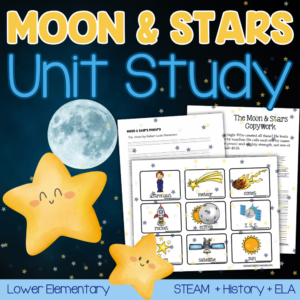
This moon & stars unit study is for preschool, kindergarten, and early elementary students learning about our closest neighbor in space, the moon, as well as the stars in our galaxy and astronomy.
Your students will make moon craters; study and learn the major constellations; discover (and taste!) the phases of the moon; what gravity has to do with Jackson Pollock’s art; count how many zeros are in 100 billion; find out why Galileo is famous and what he discovered; and much more in this fun family-style outer space Moon and Stars Unit Study.
There are four individual units within this Astronomy and Astronauts unit study:
Moon and Stars: Early Learners, Upper Elementary, Middle & High School
Space and Planets: Early Learners, Upper Elementary, Middle & High School
Rockets and Spacecraft: Early Learners, Upper Elementary, Middle & High School
Astronauts: Early Learners, Upper Elementary, Middle & High School
Some links in this post may be affiliate links. This means that if you click on them, I may make a tiny commission, at no extra cost to you.
Moon and Stars Language Arts
Read Aloud Living Picture Books
The Moon Book by Gail Gibbons is a comprehensive look at the Earth’s moon. This book uses easy to understand language and is therefore a read-aloud for preschoolers to 2nd grade. The text is short enough that preschoolers can attend to it and they will enjoy the illustrations. This book also works well as an independent reader for 3rd to 5th grade. The Moon Book is filled with facts, vocabulary, and even a few folktales about the moon.
Henry’s Stars by David Elliot is a sweet picture book for preschoolers that explores the idea of constellations. Henry and his farm animal friends notice that the stars make shapes. Great introduction to constellations for little ones!
A Hundred Billion Trillion Stars by Seth Fishman explores the amazing vastness of the universe in a fun way. This book is also a nice introduction to large numbers. Be sure to read the author and illustrator biographies at the back of the book, too.
The Moon Over Star by Dianna Hutts Aston is about a little girl named Mae (possibly a nod to astronaut Mae Jemison). She dreams of becoming an astronaut after witnessing the lunar landing on television in 1969.
Stars, Moon, and Clouds by Eugene Bradley Coco is a sweet, fiction story of a little boy who collects some stars, the moon, and some clouds to keep in his room. After discovering how unhappy the stars, moon, and clouds are, he sets them back in the
Twinkle Twinkle Little Star: I Know Exactly What You Are by Julia Kregenow is the perfect family morning basket time book. The first half of the book is a preschool to early elementary picture book based on the popular nursery rhyme, only using astronomy vocabulary and details. The second half is an upper elementary to middle school book focusing on how stars are created, what they’re made of and why they look like they are twinkling.
Poetry
Read this poem to your children, and encourage them to memorize it. This Twinkle Twinkle Little Star is probably very familiar to you and your children as a child’s fingerplay song. I didn’t know all of the verses though and I thought you and your children might enjoy learning them. The original poem was written
Twinkle, twinkle, little star,
How I wonder what you are!
Up above the world so high,
Like a diamond in the sky.

When the blazing sun is gone,
When he nothing shines upon,
Then you show your little light,
Twinkle, twinkle, all the night.

Then the trav'ller in the dark,
Thanks you for your tiny spark,
He could not see which way to go,
If you did not twinkle so.

In the dark blue sky you keep,
And often thro' my curtains peep,
For you never shut your eye,
Till the sun is in the sky.

'Tis your bright and tiny spark,
Lights the trav'ller in the dark,
Tho' I know not what you are,
Twinkle, twinkle, little star.
Vocabulary

Use the vocabulary cards to make sure that your students understand all of the different words and can use them properly in a sentence. You can then use these picture cards as a word wall, as flash cards, for copywork, or as spelling words.
Listening Comprehension

After reading aloud The Moon Book by Gail Gibbons, or similar title, filled the facts about the moon, go back through the book with your child to review the facts discussed in the book. Then, use this worksheet from our Free Resource Library to ask your child questions about the moon and to record their answers.
Not a member of the Whole Child Homeschool Tribe yet? Use the bright pink box below to sign up and get immediate access to the Free Resource Library.
Narration
For families that use narration to work on grammar, here is a narration page from our Free Resource Library with quotes from Gail Gibbon’s The Moon Book for your first and second graders.
For the narration pages, select the passage that best matches your child’s writing and spelling abilities. Then, read the passage to your student all the way through first. Then read it again, 2 or 3 words at a time, giving them time to write it down. Tell them to do their best, but not to get “caught up” in making sure it’s all spelled correctly while they are writing. They can go back when they are done to fix any spelling if they want.
When they are done, give them the original page (that you read off of) and let them “check” it and fix any spelling or punctuation mistakes. Talk to them about any spelling or punctuation rules that they used, just to help cement it in their brains. It’s really important for them to check it, not you. It seems to give them ownership of it and makes them remember the correction.
Use the Rockets & Spacecraft Copywork Worksheets in the Free Resource Library to practice grammar and handwriting. There are 3 pages in 3 different levels for early elementary, upper elementary, and middle/high school. The early elementary and upper elementary levels come in both print and cursive.
Folklore
Listen to the Circle Round podcast “The Woman in the Moon”
Biographical Living Book
Starry Messenger by Peter Sis is a Caldecott Honor Book that is another great family morning basket time book as it has text for younger audiences and extra facts boxes for older kids to enjoy. Tells the story of Galileo Galilei’s courageous life of standing strong for what he believed to be true.
Your younger kids will enjoy these Mae Among the Stars activities to learn more about Mae Jemison.

Moon and Stars STEAM
Nature Study of Constellations
Glow in the Dark Constellations: A Field Guide for Young Stargazers by C.E. Thompson is a wonderful, easy to use guide for beginning astronomers. This book is written for constellations easily seen from the continental United States. It includes details about 33 constellations plus step by step directions for viewing each. Most constellations are named after Greek and Roman gods, and so it includes a bit of the accompanying myth for each of the Greek and Roman gods. Your older kids may become interested in learning more about Greek and Roman mythology.
Learn more about the stars and constellations in this Star Light, Star Bright article.
Hands-On Science
Read about Earth’s moon to learn some interesting facts. Next, go to NASA’s site to find out the names of the moon’s different phases (or shapes). Watch this video from SciShowKids to learn about the moon’s phases.

A moon and stars unit study wouldn’t be complete without Oreo cookies! Use the Oreo moon phases matching worksheet from the Moon and Stars Unit Study Bundle. Then grab some Oreos to replicate the phases of the moon after reading The Moon Book by Gail Gibbons.
Depending on your young learners abilities, you can probably do some of the hands-on activities from the Upper Elementary’s hands-on science section: Eyewitness Explorer Night Sky Detective has great hands-on activities. To begin this week, explore gravity and make moon craters as described on page 21. Second, check out the phases of the moon while you chart the moon (page 22). Finally, learn why the moon doesn’t totally disappear during a lunar eclipse using the activity on page 25.
Read Gravity by Jason Chin, then explore gravity with expandable water beads on a marble run.


-
 Product on saleAstronomy to Astronauts Outer Space Bundle: All 4 Unit Studies in OneOriginal price was: $56.00.$40.00Current price is: $40.00.

Fine Motor and Art

We made these sticker & chalk constellations with star stickers and sidewalk chalk on black construction paper. You can have your kids make up their own constellation. Then, they can give it a name, and tell where to look for it in the sky. Or, you may want to help your younger kids place their stars into the shape of the first letter of their name, if they are working on letter identification.
Practice drawing letters in a moon dust writing tray, like this one.
Moon and Stars Extras
Sensory Exploration

This sensory bag is great for toddlers to explore by moving the stars around with their hands and is fabulous fine motor work, too!
Preschoolers and early elementary
Making a sensory bag is super easy and cheap! I used a

Play dough is an easy way to get some heavy work, proprioceptive sensory play into your preschooler’s day. Add in some star cookie cutters for themed play. Two of my youngest have a severe gluten allergy, so I make a gluten free play clay for them (pictured above).
Social-Emotional Growth
Stars Above Us by Geoffrey Norman tells of a girl who is afraid of the dark and whose father is a soldier about to be deployed. Her father helps her overcome her fear of the dark while helping her to feel connected to him. A comforting story for kids who are afraid of the dark.
This short video by Story Bots gives kids some concrete examples of strategies to try when something is scaring them.
Devotions
If you would like to add Bible study to your morning time, your family will love the devotional book Indescribable: 100 Devotions about God and Science by Louie Giglio. These five
More Ideas for Learning about Outer Space
Family schooling naturally has overlap between learner’s abilities. That’s why morning baskets and unit studies work so well for larger homeschool families! Therefore, there may be activities detailed in another level that will still be of benefit to your family even if you don’t have any students working at a different level. Check them out below:
Moon and Stars: Early Learners, Upper Elementary, Middle to High School
Check out my Astronomy and Astronauts Pinterest Board for more ideas!
Pin this to your favorite board so you can find it again! And be sure to follow Whole Child Homeschool on Pinterest for 1000s of Free Homeschooling Resources and Ideas!


