
Organizational Strategies for ADHD to Improve Your Student’s Focus
Learn what organizational strategies for ADHD you can use in your homeschool to help your distractable child better focus and learn while homeschooling. Perfect for kiddos with any unique learning needs!

As a homeschooling mom, you’ve probably read the book If You Give a Mouse a Cookie by Laura Numeroff and seen some of the parodies and poems based upon it. My family often jokes that we all have the same problem as the Mouse in the book because we all have ADHD to some degree.
For example, we start on a project or task, but it reminds us of something else that we also need to do, so we start on that. And then get sidetracked again with something else and before you know it, the day is gone. We haven’t finished any single task even though we were busy the whole day.
My family’s biggest challenges are impulsiveness and failure to complete a task. So as a family, we’ve come up with several strategies for ADHD to help us stay on track and complete our tasks.
My background as a Speech-Language Pathologist plus my experience as a homeschooling mom since 2001 has helped me to come up with some ADHD strategies, or ways for myself and my kids to combat the distractions. Even though my oldest has struggled with ADHD, she was admitted to Honors College at the university of her choice and has since graduated.

My younger kids with ADHD are still homeschooling at the high school, elementary, and preschool levels and we are always striving to learn more ways to overcome distractions.
To learn more about ADHD (and the different types), read this article about the 7 Types of ADHD.
If you are a mom with ADHD, check out this good daily list of things for moms to do.
Do your kiddos with ADHD tend to tell lies, even when it doesn’t make any sense? Learn about the connections between ADHD, Lying, and Executive Functions in this “Why ADHD Kids Tell Lies” article.
To listen to a podcast that I did with Abby Banks from Homeschool with Moxie about these organizational strategies for ADHD, click here
Some links in this post may be affiliate links. This means that if you click on them, I may make a tiny commission, at no extra cost to you.
Here are some of the organizational strategies for ADHD that my family uses to overcome our challenges with ADHD.

1. Work Bins or Workboxes Strategy
If you aren’t familiar with work bins, it’s basically just an organizational system of numbered boxes or bins with one task placed in each box. Sue Patrick originally came up with the strategy of organizing school work in workboxes for her son with special needs. A typical day of work bins might look like this:
- math flashcards
- math worksheet
- quick card game with mom
- science reading
- supplies for a science experiment
- free reading book
- spelling activity
- grammar game
If your family has a morning basket time when the family does their “together” work (or family schooling time), then
For example, we like to use small puzzles, fidget gadgets, a coloring page, brain break dice or cards, 1 person logic challenges, or even quick card games that take less than 5 minutes to play.
Work bins work especially well as one of the ADHD strategies for younger children and for those who need lots of hands-on activities. They are also a wonderful way to encourage independence as kids can go through and complete their work without having to continuously stop and ask mom “what’s next?”!
Many families like to use these rolling cart bins for their workboxes.
2. Visual Task Cards Strategy

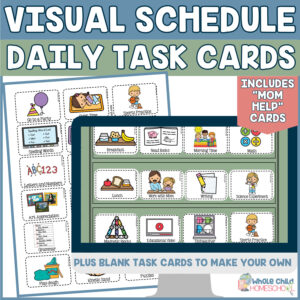
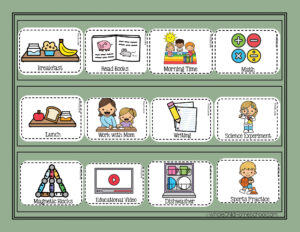
We use our
- breakfast, morning chores
- morning time basket
- bins 1 to 3
- 15 minutes of playtime
- lunch
- bins 4-6
- dentist appointment
- bins 7-8
- supper
- hockey practice
- shower
- evening chores
- bedtime
Using the daily tasks cards chart has also helped my preschoolers with the pre-reading skills of scanning their chart from left to right and understanding that pictures and symbols stand for words.
Get your own {FREE} sampler of the Daily Task Cards and Chart.
It has three pages of daily tasks cards plus the chart so you can create your own custom visual schedule!
Or get the Full Package at an affordable price in the WCH Resource Store!


3. Assignment Notebooks Strategy
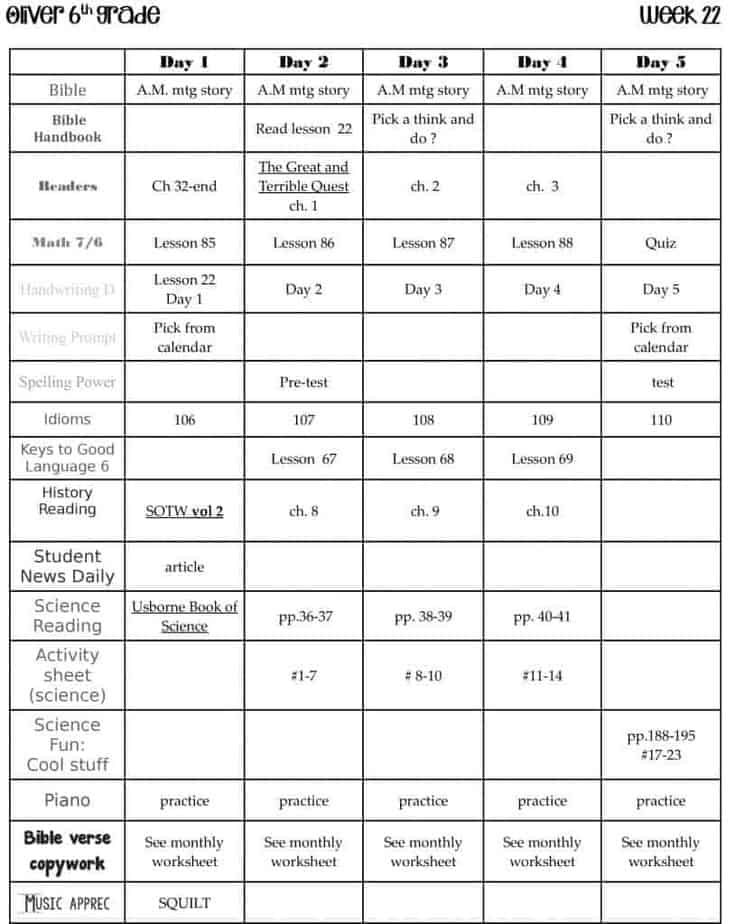
I spend about a week each summer typing up each child’s lesson plans for the year; print them out and place them in a 3-ring binder. As they complete an assignment, they can highlight it.
This visual aid works really well for older kiddos to see what they’ve accomplished, what they have left to do for the day, and as an added bonus, is a great record-keeping system for moms, too.
We also use MOM Cards for them to ask for help (this is especially good for kiddos who think they need you to sit and watch them work). Learn more about the MOM cards and get your own here.
For younger kids, I highlight their tasks after they’ve completed that work bin item. You can read about how I plan our lessons for the whole year here and get {FREE} printable planner forms from the Free Resource Library.
4. Sitting Strategy
For most school tasks, I’ve let my children sit/sprawl however they’ve needed, but there are times when being able to sit in a chair without falling off of it is helpful. We found that using a flat balance ball type of seat cushion helped with the constant wiggles and falling out of chairs. (Because constantly falling out of chairs is a very real thing!)
Find more of the supplies and materials that I recommend in this “School Supplies for Unique Learners” post
5. Listening Strategy
My kids are visual learners and they struggle most with tasks that require good auditory listening skills.
I know that most traditional university classrooms are based upon a lecture/note-taking style, so to help them prepare for that I started a couple of different strategies when they were young.
First, I let them have a special toy to fiddle with while they were listening. My kids especially like the Tangle Jr. toy but other quiet toys, like a squishy stress ball, fidget spinner, or a fidget cube, work equally well.
Second, we listened to audiobooks while we ran errands and drove to extra-curricular activities. Our favorites are Jim Weiss Audio Collection and Hank the Cowdog books.
Third, we listen to a chapter of the Bible each day, and afterward, each child has to tell me one or two things that they heard. When they are 3 or 4, they may only be able to tell me a single word that they heard. As they get older, they tell me phrases and then sentences that they remember. Eventually, with a lot of practice, they are able to summarize what they heard.
6. Curriculum Strategy
We’ve found that combining as much hands-on curriculum as we can find along with a morning family school time works really well at holding our attention.
We’ve used
What is a Lapbook, Anyway?
If you have been homeschooling for a while, you have probably heard someone mention lapbooks. But exactly what IS a lapbook? Find out HERE
When my oldest two were in high school, I taught an American History through Film class through our co-op, which was very beneficial for my visual learners. Find all of the History through Movies lists here.
7. Remove Distractions Strategy
Often when I’m working, I’ll see something moving outside out of the corner of my eye, which causes me to stop what I’m doing to look and see what is outside the window (usually it’s just a chicken!). But then it’s easy to be distracted by other things in the room. My kids deal with the same types of distractions, so I bought a large trifold poster from the dollar store for each of them (it’s the kind that is used for science fair presentations). Usually these only last for about a year before they fall apart because my kids aren’t very gentle with them, but they are only a dollar apiece.
One year, I let them “decorate” their folders, but I soon found out that was a mistake because they spent more time adding additional decorations than they spent on their math lessons.
Also, noise cancelling headphones playing classical music (without words) also helped them to stay focused on the task without looking around each time they heard a small noise.
8. Attention to Details Strategy
Kids who are easily distractable often find it hard to notice and remember details. I’ve helped my kiddos practice details in several ways.
To make it fun, try playing some visual games like “Spot It” to help them focus on small visual cues.
To help them with auditory details, I often read our history lesson aloud. Then they tell me some of the things they heard. We also use narration as a way to learn grammar and the details of punctuation. To use narration in your homeschool, follow these directions:
For narration, select a passage that best matches your child’s writing and spelling abilities. Then, read the passage to your student all the way through first. Then read it again, 2 or 3 words at a time, giving them time to write it down. Tell them to do their best, but not to get “caught up” in making sure it’s all spelled correctly while they are writing. They can go back when they are done to fix any spelling if they want.
When they are done, give them the original page (that you read off of) and let them “check” it and fix any spelling or punctuation mistakes. Talk to them about any spelling or punctuation rules that they used, just to help cement it in their brains. It’s really important for them to check it, not you. It seems to give them ownership of it and makes them remember the correction.
9. Reward Strategy
Finding out what motivates each individual child requires lots of trial and error, but I think the blood, sweat, and tears (kidding/not kidding) involved are worth it in the long term.
One of my kids responded well to rewards for completing tasks, but never cared if privileges were taken away for not finishing a task.
Another child was willing to complete any task as long as I added in coloring or painting as the last task of the school day.
Here are a few other ideas for rewards:
- Play a game with mom (Uno Flip is currently our number one favorite!)
- Play with Kinetic Sand
- Sticker Sheets (we love the Melissa and Doug reusable sticker scenes and the Sticker plus Coloring pages)
- Cook a dessert with mom
- I Spy style Thinking Putty
You may think that you don’t have time for these rewards that you have to be involved in, but trust me, in the long run, you will be spending so much less time redirecting them back on task, that you will easily have the extra time for the rewards.
We use the visual schedules (above) as a visual reminder of what needed to be done; some days they need a significant amount of verbal redirection, other days, they are able to check off the tasks unsupervised.
10. Find the Reason Behind the Behavior
The biggest thing I discovered about my kids with ADHD is the reason behind their frequent unwillingness to start a task.
I just couldn’t understand why they wouldn’t just do it, instead of staring at it or whining and complaining about it for an hour!
I finally figured out that they believed it “would take too long” to complete, so they didn’t even start on it.
Once I understood that, we would play a game called “beat the timer;” I always set the timer for at least two or three times the amount of time the task should take. Mainly because I wanted them to be successful at beating the timer. It gives them a great sense of accomplishment and satisfaction to win!
One of my son’s favorite rewards for getting a certain number of school tasks completed is to play a game with me. We love Gamewright brand games, such as Feed the Kitty and Trash Pandas, because they are easy to play and usually take less than 10 minutes.
More Ideas for Organizing Your Homeschool
To learn more about work bins as one of the organizational strategies for ADHD search follow my ADHD Strategies board on Pinterest.
Be sure to pin one of these images to your favorite Pinterest board so you can refer back to it.


I am a licensed Speech and Language Pathologist, but I’m not YOUR CHILD’S Speech and Language Pathologist. If you have a concern about your child and ADHD, please contact your pediatric
This i
