
Wind and Kites Unit Study for Preschool to High School Homeschool
Get swept away with a love for kites when your children use this Wind and Kites Unit Study for homeschooling families with kids of all ages and abilities.

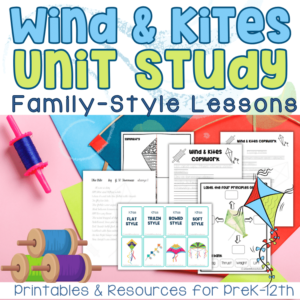
Kites are seemingly simple children’s toys, yet they are actually quite complex. You and your kids will learn all about kites & the wind they need in order to fly in this multi-subject Wind and Kites Unit Study that’s loaded with STEAM lessons and activities for preschool, elementary, middle, & high school, plus full language arts and history curriculum too.
- Learn about the parts of kites and how they fly
- Design your own kite that really flies
- Read multicultural literature and discover how much kite flying is a part of many Asian cultures
- Find out what a few weather idioms mean
- Identify how kite flying relies on math and physics concepts for success
- And much more in this Family-Style Homeschooling Unit Study!
- Early Learners: Preschool to 2nd grade
- Lower Elementary: 1st to 3rd grades
- Upper Elementary: 4th – 6th grades
- Middle & High School: 7th grade and up
This Multi-Subject Wind and Kites Unit Study is designed to be done together, as a family, with your children of all ages. Recommendations for certain age groups are given, or you can choose the activities that your kids are most interested in, or that work best for your situation.
Some links in this post may be affiliate links. This means that if you click on them, I may make a tiny commission, at no extra cost to you, but it helps to offset some of the costs of this site.
Wind and Kites English Language Arts
Family Read Aloud
The Kite Rider by Geraldine McCaughrean is Set in 13th-century China, during Kublai Khan’s reign. Also on Hoopla
Read Aloud Living Picture Books
Select a few of these suggested books:
Kite Flying by Grace Lin
K Is for Kite: God’s Springtime Alphabet by Kathy Jo Wargin Also on Hoopla
Henry & The Kite Dragon by Bruce Edward Hall. Also on OpenLibrary
Kite Day: A Bear and Mole Story by Will Hillenbrand
Independent Readers
Elementary
Flying the Dragon by Natalie Dias Lorenzi Also on Open Library
Red Kite Blue Kite by Ji-li Jiang. Please preread first as it may be too intense for adopted/trauma children. Also on OpenLibrary
Middle-High School Level
The Kite Fighters by Linda Sue Park Also on Hoopla
For Moms
The Christmas Kite by Gayle Gaymor Martin A Christian Romance
Please, please do not let your child read the book The Kite Runner by Khaled Hosseini. It has been marketed as a children’s book, a movie has been made based on the book, and it is taught in many schools. I read the book and it contains very graphic and shocking descriptions of s&xu@l child @buse. Yes, it is a well written, historical account of an important time in Afghanistan’s history, but, even as an adult, I wish I had never read it because I can never get those truly awful images out of my head.
Poetry
Read the poem, “Wind on a Hill” by Alan Alexander Milne
No one can tell me,
Nobody knows,
Where the wind comes from,
Where the wind goes.
It’s flying from somewhere
As fast as it can,
I couldn’t keep up with it,
Not if I ran.
But if I stopped holding
The string of my kite,
It would blow with the wind
For a day and a night.
And then when I found it,
Wherever it blew,
I should know that the wind
Had been going there too.A. A. Milne (shared for educational purposes only)
So then I could tell them
Where the wind goes…
But where the wind comes from
Nobody knows.
Writing Projects for Your Wind and Kites Unit Study
Creative Writing
Use the Kites Poem worksheet for all ages from the Free Resource Library. Have your students write down (or narrate for you to write) a poem about kites. The first line of their poem should be “I am a kite”.
Encourage your child to think about what she or he would see, feel, and wonder if they were bobbing at the end of a string high in the sky. It’s okay to have your younger kids tell you their answers so you can write it down for them. Little children feel empowered and excited to see their own words written.
As an extension poetry writing activity, have them write the same type of poem but use the noun WIND instead of KITE.
Idioms
A few of my kids have struggled with understanding idioms, phrases that people say, that don’t have a literal meaning. For example, if you say, “It’s raining cats and dogs,” there are no actual dogs and cats falling from the sky, right?
Read Go Fly a Kite!: (And Other Sayings We Don’t Really Mean) by Cynthia Amoroso. (Also available on Hoopla) to learn about idioms.
Then complete the Wind Idioms & Phrases worksheet from the Free Resource Library. If you have younger kids that can’t yet read, just read it to them and help them choose the correct answers. They may have already heard some of the idioms.
Grammar
Copywork and narration are real-life ways to work on grammar skills. Use the FREE Kites Copywork pages and the Narration page from the Free Resource Library. The Copywork pages come in 3 levels for Early Elementary, Upper Elementary, and Middle-High School, while there are 4 levels for the Narration selections.
Narration: After your child has written the sentence from dictation, let her see the original to check it with her work. Have her correct her work, so that she knows how it should look. Then have him re-write the selection in his very best handwriting.
Early Elementary:
Children working on the parts of speech will enjoy Kites Sail High: A Book About Verbs by Ruth Heller (Also find it for free on Open Library) for learning “what is a verb?”
Vocabulary
Use the Kites Vocabulary Flashcards from the Free Resource Library with your kids to help them learn the terminology of kites. The 20 flashcards are divided into 4 levels, but you can select which ones to use based on your child’s language and interest levels.
Folktales
Listen to The Story of Kites: Amazing Chinese Inventions by Ying Chang Compestine (also on OpenLibrary) to learn how three brothers invented a kite to keep the birds out of their rice fields. The Kang brothers are also said to have invented noodles, chopsticks, and paper.
Note: Some sources dispute where kites were first used and how they were invented, which is why I’ve placed this under Folktales instead of under History.

Wind and Kites STEAM
Science: Wind
Kites fly best on windy days. Some kites are designed for use in strong winds, while others work best in lighter winds.
If your kids don’t have any experience with flying kites, this video of a homeschooling family trying out a kite will give your kids some background knowledge of what kite flying looks like.
Early Learners:
Read this sweet book about wind, In the Wind (In the Weather) by Elizabeth Spurr or Wind (Whatever the Weather) by Carol Thompson
Talk to your kids about wind. Can they see it? How can they tell if it’s blowing? What kinds of things can happen when the wind blows? Does the wind ever blow too hard?
If it’s spring or summer, you can probably find a pinwheel at the local dollar store for your kids to experiment with and to learn about air and wind.
If you can’t find a pinwheel at a store, (or you are a crafty kinda person) you can make one following these directions and using the Printable Pinwheel Pattern in the Wind and Kites Unit Study Bundle. There are many different things you can use as a holder for your pinwheel including paper straws, unsharpened pencils, craft sticks, or our favorite, wooden skewers (like for kabobs).
Lower Elementary:
First read this book to learn about the wind, Wind: Ready-to-Read Level 1 (Weather Ready-to-Reads) by Marion Dane Bauer.
Then watch this SciShow Kids video on Where Does Wind Come From?
After reading the book and watching the video, they should be able to answer the questions (and draw pictures) in the mini book, Wind is…mini book in the Free Resource Library.
Upper Elementary:
First read this book, Feel the Wind (Let’s-Read-and-Find-Out Science 2), by Arthur Dorros. Also find it for free on the site OpenLibrary
Next, for an in-depth explanation of air, wind, air pressure, air speed & direction, and types of wind, check out this video from Harmony Square.
This short video introduces the concept of the Coriolis Effect to your children.
Look at the Parents’ Guide to Wind page in the Wind & Kites Unit Study Bundle to find questions/answers to go over with your kids.
Middle and High School:
Watch this SciShow video, What is Wind? or the Be Smart video, Why Does the Wind Blow?
For a much deeper dive into “wind”, watch the Crash Course Geography episode, Where Does Wind Come From?
This SciJinks page does a great job of explaining more about the Coriolis Effect
Technology: Flight
There are 4 principles of flight: thrust, drag, weight, and lift. Your older kids will learn more about this area of physics
Since kites can fly quite easily, they are a great way to learn more about the principles of flight, or rather, what four things need to be present in order for an object to achieve flight in the air.
Early Learners:
Watch this video explaining how kites work from South Florida PBS Then have your children complete the appropriate My Kite is… mini book for their ability (there are three choices) in the Wind & Kites Preschool Sampler in the WCH Shop.
Early Elementary:
Learn about the science of kites with this video from Learn Something New. Have them complete the Four Forces of Flight worksheet in the Wind & Kites Unit Study Bundle in the WCH Shop.
Upper Elementary:
Learn about the science of kites with ABCScience II (this video is also good for middle & high school students also who haven’t studied about air pressure or the forces of flight.
Next, go over the information about the four forces of flight with your kids.
Have them complete the Science of Kites worksheet Wind & Kites Unit Study Bundle in the WCH Shop.
Middle School/High School:
Review the four principles of flight (thrust, drag, weight, and lift) with your students using this material from NASA.
Let your students review Newton’s 3 Laws of Motion with NASA’s Beginner’s Guide to Aeronautics.
Have your student create a drawing that demonstrates Newton’s 3rd Law in regard to a surface area, such as an airplane wing (see an example in the Wind & Kites Unit Study Bundle).
If your teens are really into kites or physics, this book, Kite Physics: Visually Explained with Questions, Answers, and Experiments by Glenn Davidson, will be an excellent resource for them. It really explains the physics of flight in a visual way that makes it more understandable.
Engineering: Kites
All ages:
Label the main parts of a kite with the Parts of a Kite worksheets (select one of the three worksheets that best match your child’s ability) in the Wind and Kites Unit Study in the WCH Shop.
Learn to identify the main types of kites with the Types of Kites Flashcards in the Free Resource Library.
Choose one of these kites to construct (they are listed in order of difficulty)
- Make a donut-shaped kite from a paper plate and fabric scraps with Angie Holden
- The DadLab shows how to make a simple kite with just paper, string, and a stapler
- Use these instructions from SciShow Kids to make your own kite (that actually flies!) from a plastic tablecloth from the dollar store, string, and 2 dowel rods.
- NanoGirl teaches how to make a kite similar to the one above from SciShow Kids
- Make a Delta kite with Classy Inventor or try this super high-flying, ultra-light kite
- Flying Master shows how to make 5 different animal-shaped kites
- Find dozens more plans with 1 to 4 lines and increasing difficulty at KitePlans
Middle/High School:
Learn about the Bernoulli Principle and then watch this video that demonstrates this principle of physics.
Have your student demonstrate and explain the Bernoulli Principle to you using only a piece of paper and their breath (*it is sometimes also called the Bernoulli Effect). If they struggle with finding words to explain it, have them draw a picture of how it works.
Ask them to state at least two ways that the Bernoulli Principle is used in real life. (If they can’t come up with any real-life applications, go over this information from Science Clarified with them.
If your students have completed advanced algebra, let them work the Bernoulli Equations on Teach Engineering.
Complete this experiment from Science Buddies to see how the kite tail helps the kite to fly.
Math: Symmetry, Ratios, & Proportional Relationships
Early Learners and Early Elementary:
Read Let’s Fly a Kite (Mathstart) by Stuart Murphy to learn about symmetry (this book is also available as a free ebook on Open Library.
Have your kids make a symmetrical kite by folding a sheet of paper in half and drawing one side of the kite along the fold. Cut out the shape; open the paper up and let them decorate the kite. Encourage them to make the design and colors the same for both sides.
Your youngest kiddos may also enjoy these spring color by number or these other spring color by number printables with more seasonal spring themes such as butterflies, tulips, and umbrellas.
Upper Elementary:
Ratio and Proportion Have you noticed that kites are symmetrical and not just random amoeba shaped? That’s because kites that are made with proper ratios and proportional relationships will fly better.
Complete the Kite Math Ratios worksheet (Level A) in the Wind and Kites Unit Study in the WCH Shop to make your kite have the correct ratio of length and width, and to find the correct ratio based on the lengths.
Finally, make cherry limeades for all of the members of your family using ratios and this recipe. For example, if there are 5 people in your family, you’d calculate the amount of each ingredient needed with a 5:1 ratio. Find a printable copy of this recipe in the Free Resource Library.

Cherry Limeade
* 2 Tablespoons Lime Juice
* 1 1/2 Tablespoons Granulated Sugar
* 1 1/2 Tablespoons Warm Water
Stir together in a glass until sugar is dissolved.
Add in:
3/4 cup of Cold Water
1 1/2 Tablespoons of Maraschino Cherry Juice (from the jar of maraschino cherries)
3 Tablespoons Lemon-Lime soda (like Sprite)
Top with a maraschino cherry. Serves 1.
Middle & High School:
First have your students complete one of the Kite Math Ratios worksheets (based on their math proficiency) in the Wind & Kites Unit Study in the WCH Shop.
If your high school student has not taken geometry or has just started taking geometry, have them first watch this about the properties of a kite.
If your child has already taken geometry, (or knows how to do “proofs”) let them first watch this from The Organic Chemistry Tutor, and then they can complete this one to prove that a quadrilateral is a kite.
Wind and Kites Arts
Applied Arts
Early Learners:
Complete one of these fun upcycled art projects from Happy Hooligans: Wind & Sun Catcher, Pringles Can Wind Sock; or a paper bag kite from Somewhat Simple.
Elementary:
Design a bird kite like Krokotok, making sure that the design is symmetrical
Middle/High School:
Design an animal or character kite, being sure that the proportional relationships are correct and the sides are symmetrical.
Fine Arts
Take a look at the painting, Boys Flying Kites, by Justus de Gelder (provided in the Wind & Kites Unit Study in the WCH Shop). Ask your children open-ended questions about the painting, such as “What do you think the boy who is seated and facing you is looking at?” or “What things from nature do you see in this painting?”
Justus de Gelder (1650 to sometime after 1707 and before 1724) was the stepson of Nicolaes Maes (1634-1693). Many of de Gelder’s paintings were originally incorrectly attributed to his stepfather, who was a professional artist, whereas de Gelder was probably a merchant and town alderman. de Gelder and Maes both painted in a Rembrandt-esque manner and lived in and around Amsterdam.
Music
Flash mob in the UK of Let’s Go Fly a Kite
Mary Poppins Let’s Go Fly a Kite Sing-a-long with Julie Andrews and Dick Van Dyke
History of Kites
All:
Learn how to say kite in different languages from around the world
Kites were used to communicate during wars; for experiments to learn about our world (Ben Franklin, anyone? and Alexander Graham Bell), and even as a test model for the Wright Brothers’ first airplane.
Early Learners:
Read The Emperor and the Kite by Jane Yolen to learn about kites in Ancient China.
Have your child draw a picture of the story. Use the Kites in Ancient China printable from the Free Resource Library as a frame for the drawing.
All Elementary:
Read The Kite that Bridged Two Nations: Homan Walsh and the First Niagara Suspension Bridge by Alexis O’Neal about a kite that helped to build a suspension bridge or Kites: Magic Wishes That Fly Up to the Sky by Demi about the history of kites in China and the Double Ninth Festival (mentions Chinese “gods”).
Upper Elementary:
Research and learn more about one of stories above using the resources below:
The first Niagara Suspension Bridge
Use one of the Kites Notebooking pages from our sister site, HHO, (included in the Wind & Kites Unit Study Bundle) and have them write 3 to 9 sentences about it.
Middle/High School:
For a history of the origins of kites, watch this video from Archaeosoup.
Select one of the ways kites were used by militaries and compare that use of ancient kites to modern-day drones & balloons used by militaries. Have your students write a five paragraph essay comparing and contrasting.
Family Movies about Kites
Berenstain Bears: The Big Red Kite the kite story begins at timestamp 12:05
Mary Poppins G 1964 with the famous song, Let’s Go Fly a Kite. This movie is over 2 hours, so you might want to split it into two sections for your younger kids.
Fly Away Home PG 1996 While not technically about a kite, but rather an ultra-light hand-glider type of aircraft, this is still a heartwarming story about family and flight.
For your teens, Saving Mr. Banks PG-13 2013 A movie about Walt Disney wanting to buy the rights to P.L. Travers’ Mary Poppins story. Sounds dull, but really has some depth to it and is quite good. A great movie for your older kids, but not for young ones.
Do you have kids at multiple ages and stages, but just want the printables?


Do you only have early learners right now? Get a sample of some of the preschool and kindergarten printables


Do you want to get all of the instructions & printables in one easy download, so you can do this unit again when your kids get bigger?
Extras for Your Wind and Kites Unit Study
Free Kite notebooking and journaling pages in 3 levels (9 pages total) from our sister site, Homeschool Helper Online (includes more links and book recommendations too!)
Alexander Graham Bell, the inventor of the telephone, thought that the future of flight would be through giant box kites (!), not airplanes.
With a Kite takes a look at the legit sport kiteboarding
TestFlite demonstrates a stunt kite and shows the “wind window”
If your students need a science fair project for your local co-op, check out these two from Science Buddies: (sometimes this site wants me to log in, but it’s free to do so)
- Let’s Go Fly a Kite (beginner level)
- The Wright Stuff: Using Kites to Study Aerodynamics (Intermediate level)
- How Low Can It Go? Design a Kite that Flies Best in Low Winds (intermediate level) *this one is more expensive to complete
Makar Sankranti is an important festival for the Hindus every year when the sun changes from winter to spring. Kites are a large part of the celebrations. If you are interested in this Indian festival, you can learn how about it with ArtsyCraftsyMom.

Be sure to follow my Pinterest board of Family Unit Studies for more great hands-on activities and ideas for your family!
And most importantly, pin this post so you can refer back to it during your Wind & Kites unit study.

