
Native American Unit Study for Homeschool Students in 3rd to 9th grades
Help your kids learn about the history, culture, and traditions of the 500 Nations in this Native American unit study for homeschool using notebooking and hands-on experiences.

This Native American Unit Study for Homeschool is just a general beginning to the history and lives of the Indigenous peoples of North America. I made this unit study to give my kids a general overview of the Native American’s way of life and the things they have endured.
This unit is by no means a complete examination of Native American’s history. As we study more of North American history my kids will learn about other events that involved the Native Americans but for now I wanted them to have a broad overview that concentrated solely on these proud people and their heritage. This five-week unit study covers most subjects including practical and fine arts, but you will need to add a daily math for a full curriculum.
Along with the family read-aloud books, your students will independently read the suggested Native American Unit Study books, and watch the recommended movies depicting the Native American’s way of life. They will also complete many different homeschool Native American crafts and the Native American homeschooling activities and lessons. Students will research and report on 15 different famous Native Americans, 15 different Nations, and 11 different historical events that effected the indigenous peoples.
This Native American Unit Study is best for 3rd – 9th grades.
Native American Unit Study Library List (Required Books)
Read Aloud Books
The Book of Indians by Holling C. Holling (for specific events) This book was OOP for many years, but is finally being published again!! You can also read it on Open Library for free.
Blackfeet Indian Stories by George Bird Grinnell (literature reading) Also on Open Library
The Buffalo and the Indians: A Shared Destiny by Dorothy Hinshaw (for Native American culture) Also available on Open Library.
In Their Own Words: Sitting Bull by Peter and Connie Roop (a biography) Also on Open Library
Wigwam and the Longhouse by Charlotte Yue (Native American housing) This title is not on Open Library, but you may be able to find a copy at your local library.
For Upper Elementary
If You Lived with the Hopi by Anne Kamma (for Native American culture) OOP, but it’s easy to find used copies. Also look for If You Lived with the Sioux Indians by Ann McGovern (also on Open Library), or If You Lived with the Iroquois by Ellen Levine (also on Open Library), or If You Lived with the Cherokee by Peter Roop
The Double Life of Pocahontas by Jean Fritz (a biography) Also as audio book on Hoopla
Om-Kas-toe of the Blackfeet by Kenneth Thomasma * Also available on Open Library
Hidden Roots by Joseph Bruchac Also on Open Library
For Middle and High School
Squanto by Feenie Ziner (This biography is OOP; find it on Open Library, may also be titled Dark Pilgrim: The Story of Squanto)
Indians: A Pictorial Recreation of American Indian Life Before the Arrival of the White Man by Edwin Tunis OOP, Read it for free on Open Library
Crazy Horse by Judith St. George Read it on Kindle Unlimited or Open Library
Indian Captive: The Story of Mary Jemison by Lois Lenski * Find the audio book on Hoopla, or read the ebook on Open Library
Mean Spirit by Linda Hogan Also on Open Library
*highly recommended for your home library
Additional (Optional) Native American Books
Children of Native America Today by Dennis and Hirschfelder Also on Open Library
The Timucua Indians — A Native American Detective Story by Kelley G. Weitzel
Sequoyah: The Cherokee Man Who Gave His People Writing by James Rumford
The Cheyenne: A First Americans Book by Virginia Driving Hawk Sneve This author has several more books in the same “First Americans” series like The Navajos, The Apaches, The Cherokee, The Hopi, The Cheyennes, The Nez Perce, The Iroquois, The Seminoles, and The Sioux that will be very helpful.
My Heart is on the Ground: The Diary of Nannie Little Rose, a Sioux Girl by Ann Rinaldi A Dear America series book, best for ages 9-12 Also on Open Library
The Sign of the Beaver by Elizabeth George Spear This is a book that my kids have read over and over. Also on Hoopla and Open Library
The Beaded Moccasins by Lynda Durrant A 12-year old girl is kidnapped by the Delaware tribe. As time goes by, she learns more and more of the tribes ways. Based on a true story. Also on Open Library.
Required Native American Movies
These Native American History movies are vetted for appropriateness for high school students (ages 14 and above). Some are rated R, mostly for violence, and they are noted. My family uses a filtering service like ClearPlay to watch R rated movies. It removes the foul language and bedroom scenes from both DVDs and through streaming services, and makes movies appropriate for kids 9 and up.
Alternatively, you can substitute one of the Optional movies below for the rated R movies; there are several rated G selections.
500 Nations NR 1995 This series was produced by Kevin Costner for CBS television. It does a great job of explaining both the cultures of the nations, as well as their leadership and political alliances. If you don’t want to get the DVD, you can get the book this documentary is based upon. Watch one or two of the eight segments each week.
Geronimo: An American Legend 1993 PG-13
The Last of the Mohicans 1992 R
Windtalkers 2002 R
Dances with Wolves 1990 PG-13
Spirit Rider 1993 G About the modern day culture of Native Americans
Additional (Optional) Native American Movies
Smoke Signals, PG-13 1998 A coming of age story of modern day Native Americans. First feature-length film written, directed, and produced by Native Americans to reach a wide audience
The Sign of the Beaver G 1997 Another coming of age story; explains how some Natives were tricked by the settlers into relocating.
The Light in the Forest G 1958 One of Disney’s older live-action movies. A white man who was raised by Native Americans is sent back to his biological family and must learn to fit in. Stars Fess Parker who did all of Disney’s Davy Crockett movies.
Smith! G 1969 Produced by Disney. This is an old Western starring Glenn Ford, who plays a rancher. He is friends with the Nez Perce who live near him; one of the Nez Perce is accused of murder.
King of the Grizzlies G 1970 Another older Disney movie. This one is about a grizzly bear named Wahb and a Cree who rescues him.
Alone, Yet Not Alone PG-13 2013 Based on the true story of two German immigrant girls who are taken from their families to live with Native Tribes.
Great Indian Leaders 2002 PG-13 One hour documentary about four of the most famous of the Native American leaders: Geronimo, Quanah Parker, Chief Joseph, and Crazy Horse.
Other Materials Needed for your Native American Study
- A notebook or journal. We used a 3-ring binder that we could add card stock for the plants we gathered, and also the printables from this unit.
- Yarn, string, and craft supplies like a shoebox, air-drying clay, and card board. We used several recycled bits of trash to cut and mold for the diorama.
- Corn husks (find in the produce section or at a store that has Hispanic foods)
Native American Unit Study Resources for Research
NA Culture and Traditions **this site looks like it’s from the 1990s, but it has absolutely terrific information about customs, languages, and the history of many of the 500+ tribes.
The Pre-Columbian Inhabitants of North America
Famous Native Americans Biography Resources click on the person you want to learn more about and scroll down to the “resources” section
Native North Americans of North America Playlist by Bedtime Stories Podcast
Wiccocomico: The Forgotten Tribe by The History Guy (best for middle school age)
People of the Longhouse on YouTube
Native American Vocabulary
The vocabulary words are sorted into 3 main levels, with eight words per level; find the cards in the Native American Unit Study for Homeschool Bundle. Chose which ones are appropriate for your child’s levels.
The vocabulary words are on flashcards. I recommend printing these on thicker paper like a thin card stock. Have your children cut out the cards and write the definition of the vocabulary word on the opposite side. Now they can quiz themselves by saying the definition, then turning over the card and checking their answer.
Here are some of the vocabulary words:
treaty, natives,hogan, teepee, compromise, wampum, ceremony, plains, legend, warrior, interpreter, uprising, elder, sweat lodge, powwow
By the end of this unit, your students should be able to use each of the words in a sentence.
Native American Tribes
Did you know that there are 574 “official” Native American Tribes in the United States?
For each of the following tribes, record where the tribe was located, what type of housing they used, how they dressed, and what their main diet consisted of. Also, write about their main customs and traditions. You can use the Native American Tribes notebooking worksheet (included in the Native American Unit Study for Homeschool Bundle)
Research and report on three tribes each week of this study.
- Iroquois
- Algonquian
- Cherokee
- Seminole
- Sioux
- Comanche
- Shawnee
- Nez Perce
- Tlingit (Northwest Coast)
- Inuit
- Apache
- Pueblo
- Navajo
- Hopi
- Chickasaw
Native American Historical Biographies
For each of the following people, record what tribe they were from, death and birth if you can find it. Also, write about their role in history and any interesting facts you find about them. You can use the Biography notebooking worksheet (included in the Native American Unit Study for Homeschool Bundle)
Have your students select three of these famous Native Americans and complete a biography paper for each of them each week of the unit. Make sure to record any thoughts or impressions you have about their role in history or their character. What can we learn from them?
- Osceola, born Billy Powell, Chief of the Seminole
- Tecumseh, Shawnee warrior
- American Horse, the Elder of the Lakota
- Crazy Horse, Lakota resistance leader
- Red Jacket, Seneca War Chief
- Pontiac, Ottawa Chief
- Hiawatha, Onondaga Chief
- Chief Washakie, Shoshone
- Squanto, Patuxet tribe of Wampanoags
- Red Cloud, Lakota leader and warrior
- Red Eagle, aka William Weatherford
- Cochise, Apache leader
- Powhatan, Chief of the Powhatan Confederacy
- Major Ridge, Cherokee leader or John Ross, Cherokee Chief
- Sitting Bull, Lakota Chief and Holy Man
Native American Historical Events:
There are a lot more events in Native American History than the ones listed below; see how many more you can find out about. If your students are interested, have them learn about those events as well.
Select two or three of these events to research each week of the unit study. Record the date, location, outcome of these events. Also note the causes of these events.
Research and analyze the following events. Make sure to record your thoughts and opinions about these events as well as the basic facts. You can use the Historical Event notebooking worksheet (included in the Native American Unit Study for Homeschool Bundle)(History is not worth studying if we don’t learn lessons from it)
1. Treaty of Hopewell
2. The Battle of Little Big Horn
3. Creek War and the Battle of Horseshoe Bend
4. Indian Removal Act of 1830
5. Wounded Knee Massacre
6. Red River War
7. Ute Wars
8. The Rogue River Treaty and War
9. Old Northwest Warfare
10. Starved Rock
11. The Great Giveaway of 1889 (sometimes called the Land Rush in Oklahoma)
Week 1 Activities
Read aloud: Book of Indians
Independent Reader: Indians or Native Americans
Movie: The Last of the Mohicans; 2 segments of 500 Nations
Activities:
Make a map of the Native American Tribes. *geography
Pick a Native American tribe and find out the type of home they had. Make a model of the home. Be creative with your choice of materials. Also keep it small because we will use it in a diorama in a later activity. *art
Complete the Native American Dwellings worksheets in the Native American Unit Study for Homeschool Bundle. Your students can do these all at once, or do a couple each week. Use this site for pictures of what each type of dwelling (house) looked like.* engineering and architecture
Research and complete 3 biography reports, 3 tribe reports, and 2 historical events reports this week.
Week 2 Activities
Read aloud: Sitting Bull
Independent Reader: Om-Kas-toe of the Blackfeet, Indian Captive
Movie: Dances with Wolves, 2 segments of 500 Nations
Activities:
Make a corn husk doll Note: you can easily find corn husks in the produce section of larger grocery stores, in Mexican or Hispanic food stores, or in craft stores *historical practical arts
Choose two tribes and compare them using the printable VENN diagram in the Native American Unit Study for Homeschool Bundle. *cultures and history
Native Americans use plants for many things, including for medicine and healing. Your task is to find samples of as many of these plants as you can during a nature walk. You will then put the samples in your notebook and record information about each plant in your notebook. Make sure to record its scientific name, common name, location it was found, a description of the plant, and the use of the plant. You may not be able to locate many plants in your area so an alternative would be to locate photos of these plants and record where it grows. *science connection (this project should be done over the span of the unit study).
Research and complete 3 biography reports, 3 tribe reports, and 3 historical events reports this week.
Week 3 Activities
Read aloud: Blackfeet Indian Stories
Independent Reader: Double Life of Pocahontas and Squanto
Movie: Geronimo: An American Legend, 2 segments of 500 Nations
Let your students try one of these games or this Ball and Triangle game . *historical cultures
Complete the Word Search in the Native American Unit Study for Homeschool Bundle *critical thinking
Find the census records for Native Americans in 1890 and 1990 (or just “google” the question). What tribe has the largest population? Which has the least? What is the difference between these 2 populations? Look at the top 10 populations. Was there an increase or decrease in population in the 100 years? *math
Research and complete 3 biography reports, 3 tribe reports, and 3 historical events reports this week.
Week 4 Activities
Read Aloud: The Buffalo and the Indians: a Shared Destiny
Independent Reader: If You Lived With the Hopi, Crazy Horse
Movie: The History Channel Navajo Code Talkers, 1 segment of 500 Nations
Activities:
Create a secret code using the Native American Code worksheet. Exchange secret code messages with a friend.Make sure to give your friend the secret code so they can read the message. *languages *languages and communication arts
Find out about buffalo hide paintings. Then make one of your own. You could use a brown paper bag for the buffalo hide. Crumple it up and flatten it several times to give it more of a leather look. *art
Select one of these weaving projects:
- My sister bought a weaving loom set so her kids could practice some weaving (but I think she secretly just wanted one!). You can make one from a large piece of cardboard and some string and yarn, like this one (scroll down to download the “mini-loom” instructions).
- Or get a potholder loom from your local crafting store. I found a big one and a little one at a garage sale! I recommend getting the metal one; we had a plastic one and the tines broke pretty quickly. (Both of my boys LOVED making hot pad pot holders on the loom when they were around 8-11 years old)
- Or let your kids create an original weaving project with these Navajo Craft Weaving instructions * practical arts and history
Research and complete 3 biography reports, 3 tribe reports, and 2 historical events reports this week.
Week 5 Activities
Read aloud: Wigwam and the Longhouse
Independent Reader: Mean Spirit or Hidden Roots
Movie: Windtalkers, 1 segment of 500 Nations
Activities:
Check out this list of Words in English with Native American roots (for example, papoose is an English word derived from the Algonquin.) Write these words in your notebook. (Use the Native American words worksheet).Were there any words on this list that you didn’t know? *languages
Can you think of other ways the Native American culture has influenced Western or American culture? List them in your notebook, using the Native American Culture worksheet. *social studies (sociology)
Research and complete all of the remaining biography, tribe, and historical events reports this week.
Make a dream catcher *arts and cultural history
Or your kids might prefer to use self hardening clay to make some arrow heads, instead of the dreamcatcher. *fine motor and cultural history
Make a diorama of the way an Native American village would have looked. Use the home you made earlier to use in it. *social studies and cultures
To finish up this unit make some historical Native American recipes, such as Three Sisters Soup, to serve to your family and give a presentation of what you have learned.
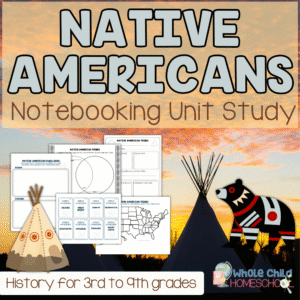
Get your copy of the Native American Unit Study for Homeschool in the Whole Child Homeschool Resource Store

You may also want to check out these Native American resources on our sister site, Homeschool Helper Online


Pilgrims and Native Americans Notebooking Printables with vetted research resources

Pin this to your favorite board so you can find it again! And be sure to follow Whole Child Homeschool on Pinterest for 1000s of Free Homeschooling Resources and Ideas!

