
Choosing Homeschool Materials When You Have a Tight Budget
Get step-by-step instructions for choosing homeschool materials that are affordable or even free to create a high quality homeschool education for your kids.

Learn how to choose all that you need for your homeschool even when you have a tiny budget and feel overwhelmed by all of the choices. A small homeschool budget doesn’t mean a low-quality homeschool education
Choosing homeschool materials can be so discouraging when times are not so great and you just don’t have a lot of extra money to spend on your homeschool. However, there’s hope!
Honestly, I’ve discovered that you can spend as much or as little money as you want or need to on homeschooling without sacrificing your child’s education.The amount you spend DOES NOT have anything to do with the quality of your family’s homeschool education.
“How much you do or don’t spend on curriculum & materials has nothing to do with the quality of a homeschooling education.“
Jenn carson
And whether you are a new homeschooler or you’ve been doing this homeschool gig for several trips around the sun…every one of us could use a few extra dollars in our bank account, am I right?
I’m going to share with you the process I’ve used for the last 20+ years (as a single-income family with 6 kids) for choosing the least expensive homeschool materials.
There are two parts to these steps that you’ll need to take before purchasing your homeschool curriculum.
First up is choosing homeschool materials, and then second, hunting down the least expensive option (I’ll walk you through that part in the next post, Finding Materials on a Tight Budget).

Some links in this post may be affiliate links. This means that if you click on them, I may make a tiny commission, at no extra cost to you. For more info, check our privacy policy.
How to Decide What Homeschool Materials to Use this Year
First step of Choosing Homeschool Resources
I always pray first over my homeschool and ask God to provide for all of our homeschool needs. God is good and I know from past experience that He always gives His children what they need (which is not always the same as what we WANT). ❤️
So, figure out how much you have to spend for the year for all of your supplies and materials (for all of your kids) in total. Write it down and then later on as you buy items, subtract from that amount.
Optional: Consider attending a local homeschool convention to browse the exhibit hall so you can physically look through the various brands of materials. It definitely gives you a different feel for the curriculum, instead of just looking a samples online. To find one near you, look at this list of state by state homeschool conventions.
Second Step of Choosing Homeschool Resources
Next, go through your stash and see what you already have that you could use. Even if you are brand new to homeschooling, I bet that you have some supplies and resources in your home.
For example, just for math, you may already have these: dominos for adding, mini erasers for sorting or learning patterns, a deck of cards for basic math facts, greater than/less than, index cards to make flashcards, a pair of dice for math facts practice.
I bet you also have pencils and notebooks left over from last year too. One of the nice side benefits of homeschooling is not needing to buy new crayons every year. 🖍️
Third Step to Choosing Homeschool Resources
If there are things in your stash that you are done with or know you aren’t going to use, sell them, and add that money to your budget.
Best places to sell? Local homeschool curriculum sales, local Facebook marketplace, and local co-op email groups.
Next Best: Look for a Facebook group that allows buying/selling of that specific publishers books and resources, i.e. A Sonlight Swap Group or find a homeschool book store that buys back books and curriculum, or at least takes them on commission.
Last, but not least: Sell your used homeschool materials on one of these sites and make sure you read the FB Groups’ Rules very carefully:
- Homeschool Classified (not a fancy site, but it’s been around for longer than I’ve been homeschooling–which is really saying something!
- Second Harvest (they only take items from certain publishers)
- Abe Books
- Thrift Books (they have a separate homeschooling section)
- Homeschool Curriculum Exchange (FB Group)
- Homeschooler Market (FB Group)
- Homeschool Curriculum Marketplace (FB Group)
Fourth Step to Choosing Homeschool Resources
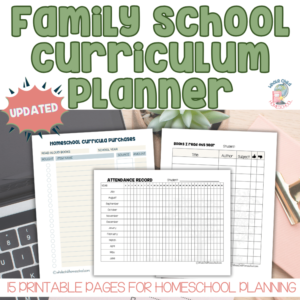
Now that you have a list of what you have and can use this year, list subjects you don’t have materials for. Print out a copy of the Curricula Planning Wish List worksheets (from the form below) to create lists of the materials and resources you need to purchase.
These Wish Lists Printables also have a column to write down the “source” that you’ll use in the next step of planning, Finding Materials on a Tight Budget, after you finish the next step of choosing materials.

Fifth and Final Step of Choosing Homeschool Resources on a Small budget
Decide what type of main curriculum you and your family want to use.
Ask yourself: do you want an open-and-go type of boxed curriculum (which typically costs 1000s of dollars), an online school (also very expensive) or do you want to pull together different materials to make up a unique curriculum that works best for your family?
To help you decide what you want to use, you can:
- Ask for recommendations in the Whole Family Homeschooling Facebook group ( or use the search feature)
- Search through the free Rainbow Resource catalog
- Ask friends (with similar homeschooling philosophies) for recommendations
- Watch YouTube or Rumble videos of homeschoolers using different styles of homeschooling
A Sampling of Inexpensive Curricula & Materials
Naturally, my first choice lately has been unit studies from this site and from our sister site, Homeschool Helper Online. HHO also has 1000s of free and affordable worksheets, notebooking pages, and lapbooks, too. But over the twenty-some years I’ve been homeschooling, I can honestly say I’ve tried 100s of different curricula with my six kids.
Here’s a list of “store-bought” homeschooling resources that I’ve used at some point in the last 20+ years of homeschooling that didn’t cost a lot and that I can wholeheartedly recommend. For consumable workbooks, if you have more than one child who will use the book at some point, I highly recommend using dry-erase pockets like these.
Language Arts
- Explode the Code Phonics books are the only phonics books you’ll ever need–great for kids with unique learning needs (and you don’t need the teacher books)
- Spelling Power The only spelling book you’ll need for all grades/ages. For all of your kids. Seriously.
- Wordly Wise If you want a separate vocabulary for your kids, this series works well, however, I don’t recommend it for kids who struggle with language and/or reading. Also, there are several editions of these workbooks, and they don’t mesh. So once you pick an edition, you’ll need to stick with it.
- If your teen is interested in pursuing any type of science career, I recommend beginning Vocabulary From Classical Roots in 9th grade
Science
- Older editions of Apologia Science
- Used copies of Real Science 4 Real Kids We used this program for a co-op with a wide range of ages and it worked well because it comes in 3 or 4 levels of student texts, while the experiments/lessons were the same for all levels.
History
If you think you need to have a “spine” textbook for history, look for one of these:
- Older editions (like from the 1990s) of Abeka’s history
- Used copies of Notgrass History and Civics–these are worthwhile for 7th to 12th grades
Math
My oldest two were my homeschooling “guinea pigs” and we tried just about every math program out there. The ones below are the ONLY ones I recommend 🙂
The first two in this list, Learning Numbers with Spunky and Study Time are a fantastic program that is based on a sweet and simple farm lifestyle theme, so the word problems are based on problems like hens and eggs, or bales of hay. My kids LOVE it!
- Conventional Arithmetic – Learning Numbers With Spunky the Donkey This program is for 1st and 2nd grades and has two workbooks for each grade. We had the teacher books too, but rarely used them. Available on Rainbow Resource
- For third grade and up, we use Study Time Arithmetic. I don’t buy the teacher guides until 5th grade (& that’s only because it takes me too long to grade otherwise). Also on Rainbow Resource.
- Older Saxon Math Textbooks If you like lots and lots of review, find an older set of Saxon Math. You don’t need the “homeschool” set or the teacher guide until 3rd or 4th grade.
- Teaching Textbooks We liked the old 2.0 version that has self-checking CDs, which you can still find sometimes. The new online version is moderately expensive and if your child doesn’t finish a level within a year of purchase, you have to buy it again.


What Do I Do Now That I’m Done Choosing Homeschool Materials for my family?
Now that you’ve chosen homeschooling materials for the year, you need to find the least expensive ones, right?😃
Go through the steps in this post on How to FIND Your Homeschool Materials on a Tight Budget
Pin this to your favorite board so you can find it again! And be sure to follow Whole Child Homeschool on Pinterest for 1000s of Free Homeschooling Resources and Ideas!

