St. Patrick STEAM Unit Study for Homeschooling Families of All Ages
A Multi-Subject St. Patrick STEAM {Science, Technology, Engineering, Arts, & Math} Family-Style Unit Study

Jump into these hands-on and real-life Ireland and St. Patrick STEAM activities and lessons about St. Patrick and the country of Ireland to learn more about Science, Technology, Engineering, Arts, & Math!
In this unit study, you and your kids will:
- learn all about snakes and how they are different from lizards (and what they have to do with St. Patrick!)
- refract light and make your own rainbow
- discover how Lasers work
- what St. Patrick has to do with engineering (spoiler: he’s the patron saint of that too!
- create a medievel illumination
- try some corned beef and cabbage
- plus calculate the percentages of 4-leaf clovers in the wild.
These St. Patrick STEAM family-style lessons are written from a protestant worldview where saints are seen as important historical figures who furthered the Christian kingdom but are not idolized.
Some links in this post may be affiliate links. This means that if you click on them, I may make a tiny commission, at no extra cost to you.
The St. Patrick STEAM lessons and activities have 3 main levels of difficulty to help you meet your child at the level they are currently working, instead of some arbitrary grade level.
The Early Learners lessons are generally for learners working at a Preschool, Kindergarten, or 1st & 2nd-grade level.
The Upper Elementary lessons are generally for learners working at 3rd to 5th-grade levels.
The Middle to High School lessons are generally for learners working at 6th to 12-grade levels.
Feel free to mix and match with the lessons and activities for the three different levels to find activities that best suit your children and their individual learning styles.
Don’t forget to check out the St. Patrick and Ireland Unit Study History and Language Arts sections, too!
St. Patrick and Ireland Unit Study STEAM Lessons
Science for Early Learners
SNAKES
Legends say that St. Patrick drove all of the snakes from Ireland. There’s a lot of debate about whether Ireland ever had any snakes to begin with, though. LOL
First, read Gail Gibbons’s book, Snakes.
Learn all about snakes in this video from Free School.
Also, watch this video from Homeschool Pop to learn more cool facts about snakes.
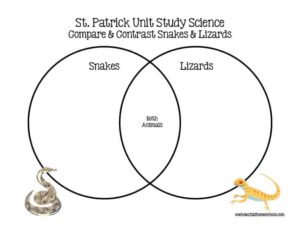
Use the Snakes v. Lizards Science Sorting worksheet from the Free Resource Library to show how snakes are different from (and also the same as) lizards.
Younger kids that can’t write could use the Snakes v. Lizards Science Sorting worksheet to sort out small plastic animals like this reptile set.
If your kids are really into snakes, print out these snake identification cards from Simple Living, Creative Learning. Or have them use the free Snakes notebooking printables from our sister site, Homeschool Helper Online, to draw and write what they’ve learned about snakes.
Science for Upper Elementary Learners
SNAKES
Learn how to tell the difference between venomous versus non-venomous snakes in this video from the Memphis Zoo.
And watch this cheesy, but funny, video from Mr. DeMaio about snakes.
Read the book, Everything You Need to Know About Snakes by DK Smithsonian to learn “everything you need to know” 😉
Learn more about snakes at DK Find Out
Use the Snakes v. Lizards Science Sorting worksheet from the Free Resource Library to write out how snakes are different from (and also the same as) lizards.
Science for Middle & High School Learners
SNAKES
Your older learners might also enjoy the video from Mr. DeMaio in the section above. Yes, it has puppets, but it’s funny in a cheesy way and gives a nod to Indiana Jones.
Watch this video from ZoneA to see the Top 10 most “beautiful snakes in the world”
Use this Snakes notebooking page from our sister site, Homeschool Helper Online to write about the differences between snakes and lizards (included in the St. Patrick and Ireland Unit Study Bundle).
Did you know that most universities have Herpetology Clubs for reptile lovers? One of my nieces discovered a love of reptiles while she was in college working at the college’s mini herpetarium and now spends a lot of her spare time “field herping”, in other words, going on hikes to look for reptiles in the wild.
Here’s an article from Reptiles Magazine if your kids want to learn more about field herping.
Technology
St. Patrick’s Day is often associated with rainbows. Rainbows appear when light is refracted and separated. Through technology, scientists created lasers in the 1950s and we use lasers in many ways today.
Rainbows
For your young children, find out how you can create rainbows at home with Kitchen Science Labs. Then, select one of the ways and make your own rainbow! Your littles will also enjoy the picture books in this list of 10 rainbow books for kids.
This video from LEGO Discover tells a bit of history about rainbows, the science behind rainbows, and how you can make one at home.
To learn how light is refracted with a triangular prism to create a rainbow (studied by Issac Newton) watch this video from Mystery Doug or this one from BBC Earth Lab.
To make your own spectrograph ( and refract light to make a rainbow) with just an empty paper towel tube and an old CD, follow these instructions from Buggy and Buddy.
Lasers
LASER is actually an acronym for Light Amplification by Stimulated Emission of Radiation.
Learn more about lasers and how they are one wavelength of light concentrated into a tube.
Synopsys tells elementary kiddos how we use lasers.
NASA’s Space Place has a simple explanation of how lasers work.
For your older kids, check out how Explain That Stuff explains lasers and
If you have high schoolers, have them watch this 5 Minute Physics lesson on lasers.
For a really cool, Wow! lesson, watch this guy from Harvard Natural Sciences use water as a laser conductor tube.
Then, see how Smarter Everyday takes lasers and fiberoptics to the next level in his kayak! He has so much enthusiasm it’s hard to not share his joy! If you only watch one of these videos, make it this one.
If your kids want to learn more about lasers, check out this inexpensive Physics Optics Laser Lab kit to create their own laser.
Engineering
St. Patrick is the patron saint of engineers. If you are scratching your head wondering what engineering has to do with a bishop from over 1500 years ago, you are not alone! Fortunately, though, 3 generations of my family have attended an engineering university where St. Patrick is the mascot, so I know the answer to this mystery. 😀
St. Patrick taught the Irish to use lime mortar instead of dry masonry and is responsible for beginning construction of their clay churches.
Mortar is what goes between the bricks or stones when building to make them “stick” together. Basically, mortar is like glue.
Early Learners
Let your kids build a house with graham crackers and frosting, using the frosting as the mortar.
Upper Elementary
This fascinating video from Discover Engineering shows 3 students who spend the day with engineering designing, building, and testing a tornado-resistant building material. Perfect for upper elementary kiddos and teens.
After you watch the Discover Engineering video, download this free lesson plan from DiscoverE to design, make, and test your own glue. The lesson is designed for kids in grades 3 to 8, but younger kids can participate with help and supervision.
Middle and High School
Engineering isn’t just math and science. Have your teens take this engineering quiz to see which type of engineering they should consider pursuing.
Then, your teens can learn the three P’s of engineering and what engineers do at work.
Just for {engineering} fun, check out this free engineering app, Truss Me, where kids can build trusses while learning finite strain theory.
Art
Fine Arts
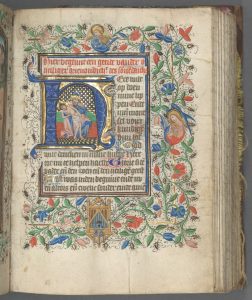
from the book Master of the Boston City of God
As a result of St. Patrick converting many of the Irish to Catholicism, monks from Ireland built monasteries (all over Europe, in fact). Monasteries became centers of community life in the Middle Ages.
Monks were among the very few literate people during this time, and they were the ones responsible for copying literature. The monks began to doodle in the margins, in what became known as illustrations or illuminations. This resulted in the literature having beautiful art in the margins and at the beginning of chapters.
To learn more about these Irish monks and their art, read the picture book, The Ink Garden of Brother Theophane, by C. M Millen and illustrated by Andrea Wisnewski.
Another good book describing the art of illuminating books and manuscripts is Marguerite Makes a Book by Bruce Robertson.
Art Application
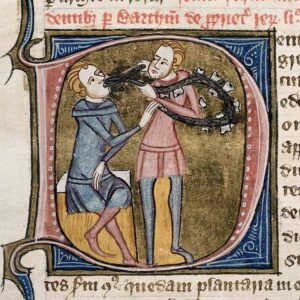
Angelic Scalliwags blog describes in detail how she and her kids re-created authentic Middle Ages illuminations, even making their own egg paints, and using feathers and gold leaf.
If you’d like to try a simpler method, create a crayon resist illumination. Have your child use a black crayon to draw their first initial, then color in with watercolors. Here are directions from Incredible Art
Practical Arts
If the number of stories, songs, and poems by the Irish about food is any indication, they must love to eat!
My family always celebrates St. Patrick’s Day by cooking a traditional meal of corned beef Reuben sandwiches. And Irish soda bread is a favorite any day of the year.
Pick the cooking project that best suits your child’s abilities.
Super Easy: Make Reuben sandwiches with just 5 ingredients. This recipe from All Recipes is exactly how we make ours.
Easy: Traditional soda bread doesn’t include raisins, but many Soda bread recipes do have raisins, which my family doesn’t care for in this type of bread. Here’s one without raisins: Irish Soda Bread from Sugar Maple Farm House. Here’s one with raisins from All Recipes.
Moderate: Make this Corned Beef and Cabbage meal from Allrecipes in your slow cooker.
Advanced: Brine a beef roast to make corned beef from scratch with these instructions from the Food Network.
Math
Early Learners
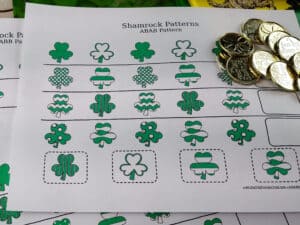
Your preschool to 1st-grade kiddos can practice their math, visual-perceptual, and language skills with the Shamrock Patterns Worksheets that are {FREE} in the Whole Child Homeschool Resource Store.
Elementary
Use the free St. Patrick’s Day addition riddles printables from Royal Baloo to practice adding single digits and solving the puzzle.
Middle and High School
St. Patrick used a 3-leaf clover to explain the trinity to the Irish. Yet, the 4-leaf clover is more commonly associated with St. Patrick’s Day.
FYI: some clovers even have 5 leaves; they’re called rose clovers.
Have your kids calculate how rare 4-leaf clovers really are in nature. Some sources say it’s 1 in 10,000, but a study of 5 million clovers found it to be closer to 1 in 5,000. Here’s the word problem for your kiddos:
“Some sources say that there are 10,000 3-leaf clovers for every 1 4-leaf clover but a study showed that the probability was actually double that occurrence. What percentage of clovers have 4 leaves?”
Get all of the printables for your St. Patrick Unit Study in ONE convenient download

More St. Patrick and Ireland Unit Study Ideas

Be sure to follow my Pinterest board Unit Studies for Homeschoolers for more great hands-on activities and ideas for your St. Patrick family-style unit study!
Don’t forget to pin this post so you can refer back to it during your St. Patrick STEAM Unit Study.